16 June 2011

Stately, plump Buck Mulligan

In honor of Bloomsday, a small collection of amusing things that I don’t understand:

1)
that do WHAT?!
(also ... it really should be “dudes who”...
not that I have an unhealthy obsession with grammar, or anything)


2)
Is this true, O California friends of mine?


3)
the magnificent six-legged grizzly bears of 1865.


P.S. We can’t have a Bloomsday without Molly Bloom’s soliloquy.

14 June 2011

Things we like VI (I think? I've lost count)

1) Sarah Vowell: for many many reasons, like: having the same passionately ambiguous relationship to America that I do; for expressing said relationship much more eloquently than I could; for being a frustrated idealist; for being a nerd; for being the most reliably witty live person I can think of:

Heaven, such as it is, is right here on earth. Behold: my revelation: I stand at the door in the morning, and lo, there is a newspaper, in sight like unto an emerald. And holy, holy, holy is the coffee, which was, and is, and is to come. And hark, I hear the voice of an angel round about the radio, saying, “Since my baby left me I found a new place to dwell.” And lo, after this I beheld a great multitude, which no man could number, of shoes. And after these things I will hasten unto a taxicab and to a theater, where a ticket will be given unto me, and lo, it will be a matinee, and a film that doeth great wonders. And when it is finished, the heavens will open, and out will cometh a rain fragrant as myrrh, and yea, I have an umbrella.

— “The End is Near, Nearer, Nearest” from Take the Cannoli


2) Yo-Yo Ma, especially in the most recent issue of Gramophone magazine, in which he is interviewed by Lang Lang, and proves himself entirely wonderful:
YM: Menuhin used to say that certain composers are less exportable than others. This reminds me of Chinese food. Do you know the Chinese delicacy, the thousand-year egg?

LL: The pidan! I tried to get my American friends to eat it and they told me to get lost.

YM: No one likes it int he West because it’s stinky. Yet Peking Duck is very exportable because it looks beautiful with its crispy skin. Someone told me yesterday that in Vietnam they drink a liqueur whose bottle contains a snake. I think it would be a little hard for me to do that. Certain things travel well, other things travel less well. I wonder if music is a bit like that.

LL: You choose the final question, Yo-Yo. Would you like to talk about Bach or about how Chinese culture has influenced Western music?

YM: Why not both? One of the things that I’ve learnt about Bach and about music in general is that there is no such thing as purity. ... It’s good for music that composers and musicians are exposed to different things, that people try to understand what they don’t understand. People need to get to a point where they feel that the thing that they don’t understand is part of them.
3) Snarky biographies, namely Harold C. Schonberg’s The Lives of the Great Composers (3rd ed.), in which the author demonstrates his apparent disdain (= jealousy!!) for certain composers near and dear to my heart:
If Bruckner’s music arouses fanatical devotion in many listeners, Mahler’s creates an actual frenzy. Again there are doubters, those who find Mahler’s music too neurotic and often too banal for enjoyment. The dedicated Mahlerian regards these unregenerates the way St. Paul regarded the heathen. It is hard to think of a composer who arouses an equal loyalty. The worship of Mahler amounts to a religion. Any music critic will attest to the fact that a response of anything except rapture to the Mahler symphonies will bring long letters of furious denunciation.
I, for one, was surprised to find out that Mahler heathens even exist. I mean ... really?


01 June 2011

OK, Computer.

I appreciate the reassurance, Computer:


but it’s not good enough anymore. There are too many things that exist that shouldn’t. For example:

1) this program Hidden, which allows you to spy on anybody who’s stolen your computer. How does it work? Well, they say:
When you activate tracking, Hidden will locate your stolen computer anywhere on the planet, collect photos of the thief and screen shots of the computer in use. (We also collect lots of nerdy network information, but we won’t bore you with the details!)
WAIT! Give me those boring nerdy details! Like: WHO ELSE CAN SPY ON ME? (
In Soviet Russia, Hidden spies YOU !!)

Don’t tell me it’s for my own good, Computer. I’m on to you.

2) The Museum of Me, featuring the Facebook Collection: this just makes me sick.

Death, oh baby ...


Things that are making me think about death:

1) One of my favorite professors, Feliz Eda Burhan, died last week; she was an amazing woman — a brilliant scholar and teacher. She was demanding and always v. critical of my writing (and I loved her for it). “This is good,” she would write on my essays, “but I know you can do better.”

A classmate of mine wrote to me to inform me of her death; she said that Professor Burhan had “passed away.” That’s what everybody said about her, actually: she passed away. I’ve always found this an incredibly strange phrase; I preferred the way another of my friends put it: that Professor Burhan had come to inhabit one of her own phrases, the “absence of presence and the presence of absence.” She is not here, but she has not passed away. In her absence is presence.


2) Mahler’s Ninth Symphony. Mahler was obsessed with death his entire career, but he was particularly afraid of the curse of the ninth — to which, in fact, he ultimately succumbed. As he was writing the Ninth, his four-and-a-half-year-old daughter suddenly died of scarlet fever; he himself was diagnosed with a fatal heart condition; WWI was rapidly approaching. So the symphony became his farewell to life — his own, and that of his entire world’s. Things fall apart; the centre cannot hold — I was thinking of this line as I listened, especially during the third movement when the cracks in the structure are revealed and everything indeed begins to crumble. The second and third movements are intense and twisted, carnivalesque, ridiculous and sinister at the same time; the first and fourth are movements of the body: the symphony begins with an irregular pulse, a hesitant arrhythmia, and the final movement ends in much the same way; it is the heart-beat slowing down.

Herbert von Karajan said that this symphony is “music coming from another world, it is coming from eternity.”

I highly recommend both the program notes by Dr. Richard E. Rodda from the performance I attended (the Colorado Symphony Orchestra, conducted by the incomparable Marin Alsop), and the essay “Late Night Thoughts on Listening to Mahler’s Ninth Symphony” by Lewis Thomas. It’s rather apocalyptic, but so is the symphony.


3) These recently-declassified photos from Hiroshima, 1945:


This one reminds me of the human body, a spine or a rib cage.

02 May 2011

kinds of freedom

I’m slightly in shock and don’t really know how to respond to this news about bin Laden — for one thing, I found about it from friends’ Facebook statuses, and that alone kind of freaked me out — and then there were the exhumed 9/11 memories to be dealt with —and then there was the fact that even though bin Laden was (to borrow a phrase from Eddie Izzard) a mass-murdering fuckhead, my country still assassinated somebody, and I can’t really accept the equation of that to “justice being served.”

So between feeling deeply confused about all that and anxiety about my show opening this week (The Odd Couple — do come see it, if you’re in the area!), I slept terribly and feel rather out of it, and am compelled to make lists.

Things that make me feel human:

1) I don’t care how many mediocre films Woody Allen has made, he is still my hero forever just for this scene: a minute and a half of Manhattan.

2) Mozart probably didn’t know this, but he wrote Don Giovanni for Cecilia Bartoli: Batti, Batti, O Bel Masetto.

3) Ai Weiwei (whose name [Ài; 艾] is a homophone for ‘love’ [ài; 愛]) is fighting for freedom of speech in China, has been censored and harassed by the government for years, and is now being held in custody for undefined “economic crimes.” Here is his TED video.


01 May 2011

in honor of the last day of national poetry month...

All You Who Sleep Tonight

All you who sleep tonight

Far from the ones you love,

No hand to left or right

And emptiness above —


Know that you aren’t alone

The whole world shares your tears,

Some for two nights or one,

And some for all their years.


— Vikram Seth

14 March 2011

The South; or, Alles wird Trauben

For the first time, really, I find myself in the southern part of the old world, and there is something peculiar about it. The quality of decay (equally of paint and morals) is entirely superior here.

Concretely, one may observe this is in the sugar packets that are three times the size of ones you would find in the new world or in northern Europe, the ubiquity and cheapness of drink, the succulents sprouting from collapsed roofs. Austerity is to be found nowhere, and particularly not in the church, where one may find the severed head of St. John the baptist and obscene gilt drapery (not painted, but carved in wood and now dripping with who knows what substance).

But, as many have observed, there is also a mental south, and this is equally irresistible and horrifying. Here, one does not dream, but is kept in a fever state. There is no future in the south, you see- only the occasional pleasure which entirely resists planning or deferral. This is why we view it as permanently youthful, despite the wrinkled facades and rotting infrastructure. The south is precisely the point at which thanatos meets eros.

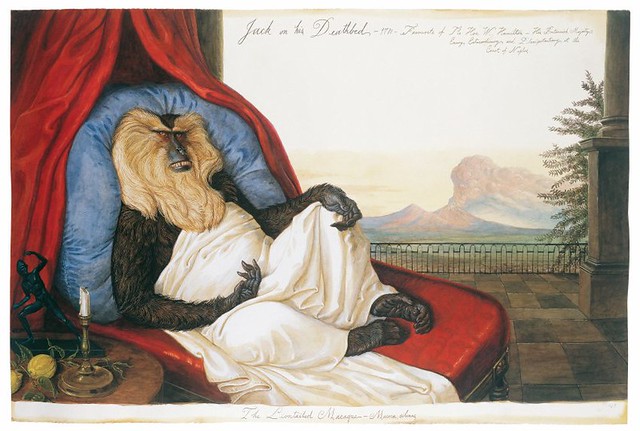
It is also 'Jack on his Deathbed,' illustrated so aptly by Walton Ford: